The last time I went deep on a restaurant chain, it kind of blew up on me. As you might remember, I’m a massive Portillo’s fan. They were on their way to Colorado, and in the last six months, they’ve paused their Denver-area expansion plans, and even worse, hired a new CFO without considering my oh-so-qualified candidacy. If you’re reading – Kevin, call me, I’ll work for Italian Beef and cake shakes.
This time, I figured I’d pick something where the final chapter had been written, so I couldn’t be held responsible. Enter Salad and Go.

For those of us outside the Southwest US, the idea of a drive-thru and pickup only salad chain sounds preposterous. And yet, at its peak, it had well nearly 150 locations, with an operating model that was nothing if not differentiated. There’s a risk of building something differently than the way the rest of the sector operates. If it works, it’s clever, and if it doesn’t, everyone sees it coming.
The story begins in 2013, like many other restaurants. A husband and wife partnership, where the husband’s mom was an immigrant who started a restaurant in her new country. Their ambition was to create highly accessible healthy options. Accessibility meant both price and location – six or seven bucks for a salad without ever getting out of your car.
This model required some very unique operational choices, including prepping most of the ingredients at centralized commissaries, so only final assembly occurs in the restaurant. This approach enabled restaurants to be the size of a coffee drive-thru, which opened up plenty of cheap, unused real estate options. Without dining rooms and centralized kitchen prep, very little labor was needed. This enabled pricing that competed with the big fast-food players, but with higher quality, better-for-you ingredients. So far – bold but strategically coherent, and not obviously flawed.
A few years after founding, the founders brought in a small consumer investment firm, Volt Investment Holdings. They aren’t exactly LCatterton – they’re small and low-profile, without a fund structure, and targeting one investment per year. The marketing feels more like a reclusive family office than independent sponsor, but I genuinely don’t know their deal.
From here, Volt and the founders scaled the company to a few dozen locations, then came some disagreement about the pace of scaling, which led to the founders exiting in 2021.
Ironically, this is when Salad and Go really hit the industry radar, through a splashy hire. Wingstop has long been a public market darling, with same-store sales growth that have dwarfed everyone else in QSR. For longtime Wingstop CEO Charlie Morrison to leave for a regional upstart shocked the industry. Morrison had been sitting on the Salad and Go board as an independent director, and when it was time to replace the founders, the call apparently came from inside the house.
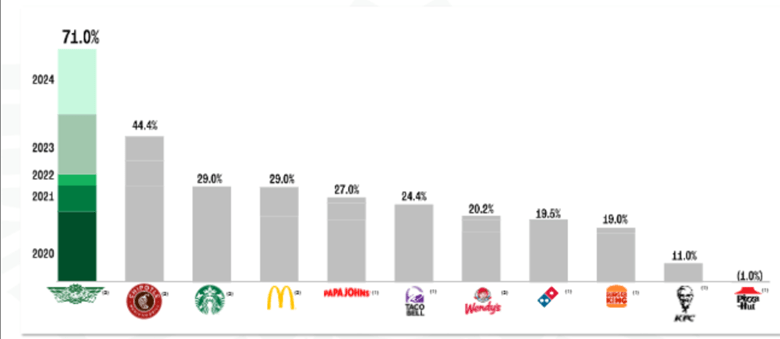
Wingstop comp-store sales were gapping the field when Morrison decided to jump ship for Salad and Go!
With Morrison in the CEO seat and the founders out of the picture, the company and investors chose to blitzscale. At this point in 2022, Salad and Go had about 50 units. Two years later, they had over 130, opening a new store per week in 2023. Morrison and company had set their sights on Texas, building a large commissary and dozens of stores for it to support. As we learned from the Portillo’s saga, Texas can be a hard place for regional restaurant chains looking to break in. I would assume has this to do with local / regional preferences and the intensity of local competition, not labor and regulatory dynamics as in California.
By 2025, the writing was on the wall. Morrison either missed the big stage or lost faith in the growth strategy and took the CEO job at Jersey Mike’s, replacing founder Peter Cancro after Blackstone acquired the sandwich business in late 2024. To the Salad and Go team’s credit, they found another heavy hitter to step in, Mike Tattersfield, former CEO of Krispy Kreme and Einstein Bros Bagels. He may not have liked what he saw, because he took quick action: 40 of the recently opened locations in Texas and Oklahoma closed in September 2025.
The company reported highly variable unit economics across its new locations – some locations were doing very well, and others were struggling massively. This illustrates a classic retail real estate issue – only so many good locations are available in a market at one time, so blitzscaling in a region can lead to falling standards, i.e. building in locations with fewer cars driving by each day than what was proven to work in Arizona.
Either the new Texas stores were struggling so badly that the team thought any additional inefficiency in centralized commissary operations would be offset by not dumping cash into struggling Texas stores, or the uniqueness of the operating model was missed by a new CEO. Krispy Kreme famously makes its donuts in-store (unlike Dunkin), so I could see a new CEO without experience in this situation making a tactical error. In most restaurants that prep and make their food on-site, when a store closes, there’s no stranded manufacturing capacity. In a manufacturing environment like a commissary, when nearly half of the stores served by that hub go dark, that commissary’s operations are going to be jeopardized, as the fixed costs can’t be effectively covered by the lower volume. Salad and Go no doubt knew about the potential for stranded cost, but did they underestimate it?
I can smell this sign. Donuts are being made here.
This played out over the coming months, and by January 2026, Salad and Go exited Texas and Oklahoma entirely, closing their remaining locations and the commissary. The commissary that was meant to support 400 stores and cost over $70m to build was empty, and dozens of stores had leases but no revenue. They put a brave face on retrenching into Arizona, but by that point, this must’ve felt like a last ditch effort.
For Salad and Go, the bitter dressing on the wilted greens ended up being cyclospora. Not because there was a single shred of contaminated iceberg in their stores, but because fear and uncertainty kept consumers away. As revenue in the remaining stores fell, eventually the cash flows from 70 stores couldn’t support corporate overhead and the massive liabilities from its failed Texas conquest. Thus, a bankruptcy filing for a company without any 3rd party debt beyond its leases, which is rare.
Rarer still is the lack of intention around restructuring. One of the benefits of corporate bankruptcy is that the debtor can renegotiate or reject contracts, including leases. Without the albatross of its failed stores and commissary, presumably there could’ve been a leaner, meaner Salad and Go. But upon announcement, it was clear there was no intent to even try to keep the company going. Maybe Volt had seen enough, but a more likely reason was the phone calls the distressed company was getting about taking over its stores.
Remember how the stores are roughly the size of a coffee drive-thru? Well, both Dutch Bros and 7Brew noticed. Dutch Bros kicked off the bankruptcy bidding at $105 million for 65 closed stores, and 7Brew put in a topping bid on Friday. They’re not in it for the salads, they’re going to convert the locations to coffee stores. Some landlords and creditors might walk away relatively unscathed, which is rare in a retail bankruptcy, particularly one where many parties made a bet on a disruptive concept that significantly overextended itself. Turns out Salad and Go was good at finding attractive small format food locations in Arizona, but bit off too much and gave themselves indigestion before they could really prove out whether their operating model was genius or crazy.

